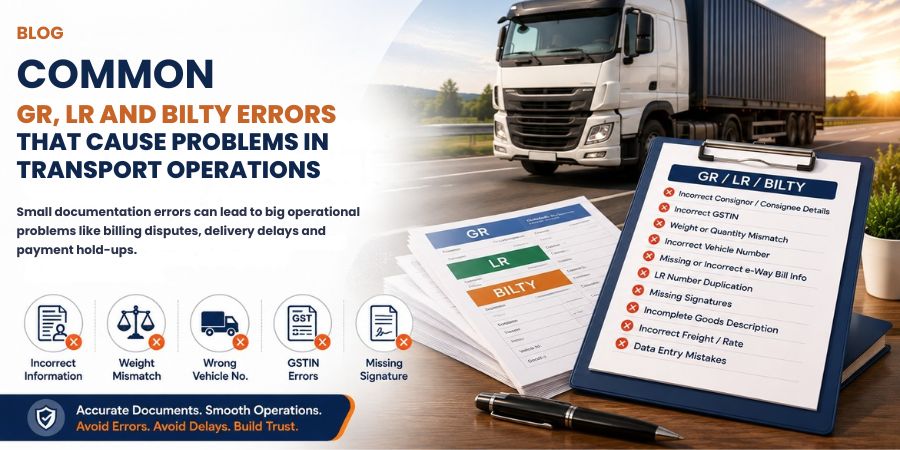
In the transportation and logistics industry, documentation plays an important role in keeping shipments, billing, compliance and deliveries organized. GR, LR and Bilty documents contain important information about the shipment, consignor, consignee, vehicle, goods, weight, freight and delivery. Even a small documentation mistake can lead to bigger operational problems. Wrong vehicle numbers, incorrect GSTIN, weight mismatches, missing signatures and duplicate LR numbers can result in billing disputes, delivery delays, payment hold-ups, compliance issues and additional administrative work. As the number of shipments increases, manually creating and managing these documents becomes more difficult. This is why many transporters are moving toward Transport Management Software (TMS) and digital documentation systems. In this blog, we will look at the most common GR, LR and Bilty errors, how they affect transport operations and how businesses can reduce these errors with better processes and technology. What Are GR, LR and Bilty? GR, LR and Bilty are commonly used terms for transport consignment documentation. The exact terminology can vary depending on the region and business practice, but these documents generally record important details about goods received by a carrier for transportation. A typical GR, LR or Bilty may contain: Consignor details Consignee details GSTIN Vehicle number Goods description Quantity Weight Freight charges LR or Bilty number Delivery information This information may also connect with invoices, e-Way Bills and Proof of Delivery (POD). Therefore, accurate GR, LR and Bilty data is essential for smooth transport operations. Why GR, LR and Bilty Accuracy Matters Transport documentation is connected to several stages of the transportation process. An error entered during shipment booking can continue through vehicle assignment, transit, delivery, POD and billing. Shipment Booking → GR/LR Creation → Vehicle Assignment → e-Way Bill → Transit → Delivery → POD → Billing For example, an incorrect weight on an LR can create a freight dispute. Similarly, incorrect consignee information can create problems during billing, reconciliation or delivery. 10 Common GR, LR and Bilty Errors in Transport Operations 1 Incorrect Consignor or Consignee Details One of the most common mistakes is entering the wrong name, address or customer information. Common causes include: Manual data entry Similar customer names Outdated records Typing mistakes Copying information from old documents Incorrect customer information can result in invoice rejection, delivery confusion, documentation mismatches, disputes and delayed payments. 2 Incorrect GSTIN GSTIN is an important part of business documentation in India. A single incorrect character can create a mismatch between transport documents and other tax-related records. Maintaining verified customer master data and automatically filling GSTIN information can reduce repetitive data entry and typing errors. 3 Weight or Quantity Mismatch Another common problem is a difference between the weight mentioned on the LR and the actual weight recorded on the weighbridge. Example: Weight on LR: 18,500 kg Weighbridge Weight: 18,100 kg Even a relatively small difference can create questions about freight charges, billing and delivery records. 4 Incorrect Vehicle Number Vehicle numbers are critical for identifying the truck assigned to a shipment. For example, entering HR55AB1234 instead of HR55BA1234 can create documentation mismatches. Vehicle number errors can affect trip records, tracking, e-Way Bill information, delivery records and billing. 5 Missing or Incorrect e-Way Bill Information Transportation documentation often needs to work together with the e-Way Bill process. When shipment information does not match across documents, it can create operational and compliance complications. 6 Duplicate GR or LR Numbers Every consignment document should have a clear and unique identification number. Duplicate numbering can occur because of handwritten registers, multiple branches, separate Excel files, manual numbering systems or poor communication. System-generated sequential GR/LR numbers can significantly reduce this problem. 7 Missing Signature or Incomplete POD Proof of Delivery is an important part of the transportation cycle. If the POD is missing or incomplete, the transporter may have difficulty proving that the shipment was successfully delivered. This can result in delayed invoicing, payment delays, customer disputes and difficulty resolving delivery claims. 8 Incorrect Goods Description or HSN Information Goods should be described accurately in transportation documentation. Problems can occur when employees use vague descriptions, select the wrong product category or enter incorrect HSN details. 9 Missing Freight and Charge Details Freight charges and other applicable transportation costs should be recorded accurately. Missing or incorrect freight information can create disputes between the transporter, consignor, consignee, accounts and operations teams. 10 Lost or Damaged Paper Documents Paper documents can easily be lost, damaged, misplaced or stored in the wrong file. This becomes a serious problem when an old GR or LR is needed for an audit, customer dispute, payment follow-up or internal verification. How GR/LR Errors Affect Transport Businesses A documentation mistake may look small, but its impact can spread across the entire operation. 1. Payment Delays Incorrect documentation can cause invoices to be rejected or placed on hold until the information is corrected. 2. Higher Administrative Work Employees may spend hours checking old documents, correcting records and reconciling data. 3. Delivery Delays Incorrect shipment or vehicle information can delay transportation operations. 4. Customer Disputes Incorrect weight, freight, delivery information or documents can create disagreements with customers. 5. Compliance Problems Incorrect or mismatched information across applicable transport documentation can increase compliance risks. 6. Poor Business Visibility Paper files and multiple spreadsheets can make it difficult for managers to understand shipment and document status. Manual GR/LR Management vs Digital GR/LR Management Factor Manual System Digital System Document Creation Handwritten / Manual System-generated Numbering Duplicate Risk Automated Numbering Customer Information Re-entered Manually Master Data Data Accuracy Higher Error Risk Validation and Automation Document Storage Physical Files Centralized Digital Records Search Time-consuming Quick Search POD Paper-based Digital POD Reporting Manual Automated Reconciliation Difficult Easier Data Visibility Limited Centralized How Transport Management Software Can Reduce GR, LR and Bilty Errors A modern Transport Management Software (TMS) can bring different parts of transportation documentation into one connected workflow. Instead of entering the same information repeatedly, businesses can maintain master records for: Customers Consignees Consignors Vehicles Drivers Goods Routes Freight rates Automated Document Generation Transport software can