
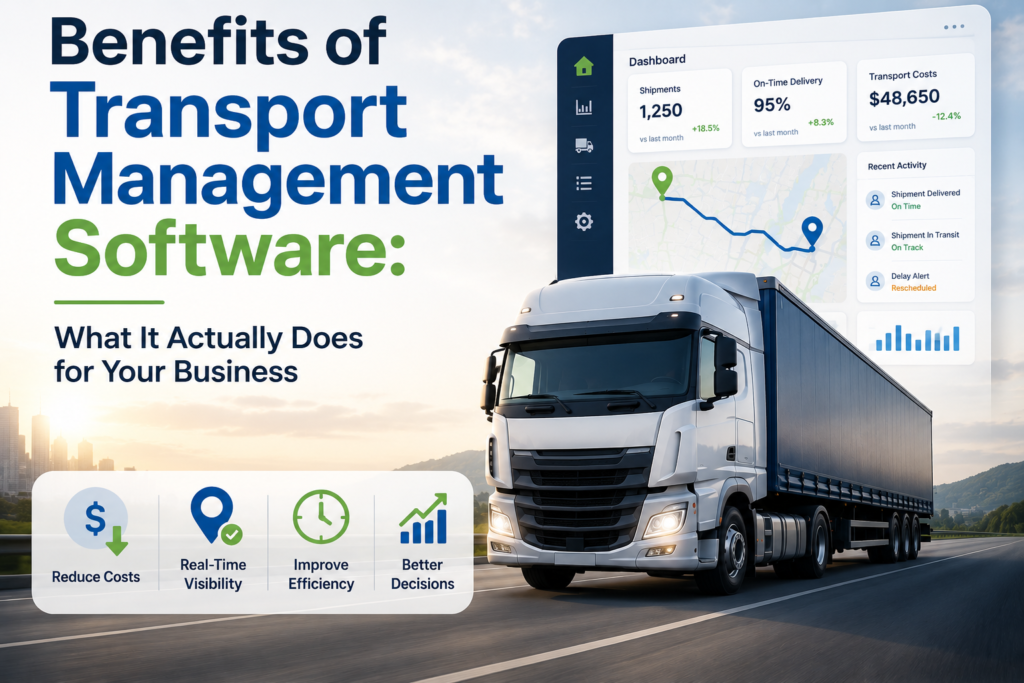
Let’s be honest managing transport operations manually is exhausting. Between coordinating drivers, chasing down invoices, handling delayed shipments, and trying to keep customers updated, it can feel like you’re constantly putting out fires instead of actually running a business.
That’s exactly why more and more logistics teams are turning to Transport Management Software. Not because it’s a trend, but becauase it genuinely solves problems that eat into your time, money, and reputation every single day.
In this blog, we’ll walk through the real-world benefits of using a Transport Management System (TMS) and why businesses that have made the switch rarely want to go back.
At its core, Transport Management Software is a tool that helps you plan, manage, and track the movement of goods from the moment an order is placed to the moment it lands at the customer’s door.
Think of it as a central control room for your entire logistics operation. Instead of juggling spreadsheets, WhatsApp messages, and phone calls with multiple carriers, everything lives in one place. Your routes, your rates, your shipments, your data — all of it, organized and accessible.
A good Transport Management System doesn’t just digitize what you’re already doing. It helps you do things you simply couldn’t do manually ike comparing 10 carrier rates in seconds, or spotting that one route that’s been quietly draining your fuel budget for months.
This is usually the first thing businesses notice after switching to a Transport Management System, and the numbers don’t lie. Most companies report saving anywhere between 10 to 30% on freight costs within the first year alone.
How? A TMS finds the money that’s slipping through the cracks. Maybe you’re running trucks at 60% capacity when you could consolidate loads and fill them up. Maybe one carrier is consistently cheaper for a particular lane, but no one’s had the time to compare. Maybe you’re overpaying on invoices because billing errors go unchecked.
Transport Management Software catches all of this automatically. It compares carrier rates, optimizes loads, flags billing discrepancies, and routes shipments smarter — so you’re not leaving money on the table without even realizing it.
There’s nothing more frustrating for a customer than calling to ask “where’s my order?” and getting a vague answer in return. It erodes trust fast.
With Transport Management Software, you have live visibility into every shipment, at any point in time. Delays, route changes, estimated arrival times — all of it shows up in real time. You can set up automatic alerts so your team gets notified the moment something goes off track, and you can even give customers a self-service tracking link so they’re not calling you in the first place.
This kind of transparency changes how customers see your business. It shifts you from reactive to proactive, which makes a bigger difference than most people expect.
Ask any dispatcher how they plan routes manually, and you’ll hear some version of “experience” or “I just know the roads.” That works — until it doesn’t. Traffic jams, road closures, new delivery windows, multiple stops with tight time slots — manual planning struggles to keep up.
A Transport Management System handles all of this in seconds. It factors in real-time traffic, delivery time windows, vehicle capacity, and road restrictions to calculate the most efficient route every time. Drivers spend less time sitting in traffic. Fuel costs go down. Deliveries arrive on time more consistently.
It’s not just about speed — it also directly cuts your operational costs and helps you meet more delivery commitments without needing to add vehicles or drivers.
If you work with multiple carriers, you know how much time goes into managing those relationships — negotiating rates, keeping track of performance, knowing who to call for which type of shipment, handling disputes.
Transport Management Software brings all of this under one roof. You can store carrier profiles, track their on-time delivery rates, compare their rates side by side, and automate the selection process based on criteria that matter to your business — cost, speed, reliability, or a combination of all three.
Over time, this data becomes genuinely valuable. You’ll know which carriers are worth negotiating better contracts with, and which ones are quietly letting your customers down.
Customers today don’t just want their orders delivered — they want to feel informed and in control throughout the process. A missed delivery, a late ETA with no explanation, or a support call that goes unanswered doesn’t just create a complaint. It often creates a lost customer.
A solid Transport Management System helps you consistently deliver a better experience. Customers get accurate ETAs, proactive updates when something changes, and the ability to track their own shipments without picking up the phone. Your support team handles fewer “where’s my order” calls. And your reputation for reliability — which is hard to build and easy to lose — stays intact.
Freight invoices. Bills of lading. Customs documents. Compliance filings. Proof of delivery. If your team is handling all of this manually, a huge chunk of their day is going toward tasks that don’t actually require human judgment — they just require accuracy and consistency.
Transport Management Software automates the bulk of this work. Invoices get matched against contracted rates automatically. Documents get generated with a few clicks. Errors that used to take days to catch get flagged instantly.
The result? Your people get their time back. They spend it on things that actually move the business forward, rather than chasing down paperwork across email chains.
One of the most underrated benefits of a Transport Management System is what happens once you’ve been using it for a few months. You start building a picture of your logistics operation that you’ve never had before.
Which routes are consistently slow? Which carriers keep missing SLAs? Which lanes cost you the most per kilometer? Are your freight costs trending up or down quarter over quarter?
This kind of insight changes how you make decisions. Instead of going with gut feel or relying on anecdotal reports, you’re making changes based on actual patterns in your own data. That’s a meaningful competitive advantage — especially in an industry where margins are tight and every efficiency counts.
Transportation compliance is complex and it varies by region, cargo type, and transport mode. Miss a required document or file something incorrectly and you’re looking at fines, shipment holds, and a lot of unnecessary stress.
Transport Management Software keeps you on the right side of regulations by automatically generating the correct documentation for each shipment — whether that’s a bill of lading, a hazmat declaration, or a customs form. It also maintains a full audit trail of every transaction, which becomes extremely useful if you ever face a regulatory review.
Less time worrying about compliance means more time focused on growth.
This one matters more than it used to. Businesses are under real pressure — from customers, investors, and regulators — to reduce their carbon footprint. And logistics is one of the biggest contributors to emissions in most supply chains.
A Transport Management System directly supports greener operations by reducing empty miles, optimizing load fill rates, and cutting unnecessary trips. Some platforms also provide carbon emission reporting, which is increasingly important for ESG disclosures and sustainability reporting.
The good news is that what’s good for the environment here is also good for your bottom line — fewer trips and better load utilization mean lower fuel costs, not just lower emissions.
Most businesses already use some combination of ERP, warehouse management, and order management tools. The problem is when these systems don’t talk to each other — you end up with data gaps, duplicate entries, and decisions being made on incomplete information.
Modern Transport Management Software is built to integrate with the tools you’re already using. Whether that’s SAP, Oracle, or a custom WMS, a well-implemented TMS becomes the connective tissue that ties your entire supply chain together. Data flows seamlessly between systems, everyone works from the same information, and you eliminate the manual handoffs that slow things down and introduce errors.
Transport Management Software often gets marketed toward large enterprises but the reality is that businesses of all sizes benefit from it. In fact, mid-size companies sometimes see the biggest gains because they’ve been stretching manual processes past their limits for years.
Industries and business types that commonly use a Transport Management System include:
If transport is a meaningful part of how your business operates, a TMS will make a difference.
Not all Transport Management Software is created equal. Before you commit, it’s worth thinking clearly about what your business actually needs.
Ask yourself: Does it scale as your volumes grow? Is it something your team will actually adopt, or will it gather dust after the first month? Does it connect with your existing systems? Can it handle the carriers and routes you use most?
These are practical questions, and the answers matter more than feature lists and demos. A TMS that looks impressive but doesn’t fit your workflows will create more problems than it solves.
Platforms like TMS Mitra are built with growing businesses in mind — straightforward to use, flexible enough to adapt to how you work, and packed with the features that actually move the needle on day-to-day logistics operations.
If your transport operations still run on spreadsheets, phone calls, and manual coordination, you’re not just working harder than you need to — you’re likely spending more and delivering less than you could be.
A Transport Management System won’t fix everything overnight, but it does create a foundation for running logistics that’s faster, smarter, and more reliable. The businesses that invest in the right tools now are the ones that will be best positioned to handle growth, rising customer expectations, and an increasingly complex supply chain environment.
TMS Mitra was built to make that transition straightforward — giving logistics teams the visibility, control, and insights they need without the steep learning curve of traditional enterprise software.
If you’re curious about how it could work for your operation, we’d love to show you around. Get in touch with us and let’s talk about what your logistics setup actually needs.

306, Third Floor, Tower A1, Corporate Park, Sector 142, Noida, Uttar Pradesh – 201 305
info@sagarinfotech.com
+91-9311746788
Copyright © 2026 Sagar Infotech, All Rights Reserved